1. The book I chose write about was the grapes of math. This book addresses symmetries and tries to teach kids how to group things together and solve equations without simply counting the number of objects up. It teaches young kids how to form and equation for the number of objects in the picture instead of simply making them count. The book goes through several different scenarios where readers are challenged to form a mathematical equation to solve the problem at hand. The problem will entail a question such as "how many holes do you see?" while reinforcing "just count the prairie dogs and subtract from the rest" to encourage more critical thinking to solve mathematical equations.
2. The book addresses symmetries but also puts an emphasis on how one is to set up an equation and get the same result as you would with counting the number of objects. The book also showed one how to look carefully at a picture to solve a problem. This book clearly shows how one can look at symmetrical pictures and be able to construct a mathematical equation to solve the task at hand.
3. I think this is effective because it shows how kids can grasp hold of mathematical concepts at a very young age and develop mathematical equations to solve problems without having to stop and count how many objects there are when they can just solve the equation in their head by looking at the symmetries of a picture. The book does a great job of stating what is effective for young students. This is a book that could prove very beneficial to many young math students.
.

Saturday, November 28, 2015

Wednesday, November 25, 2015
Blog Post #3
1. In the child's book Lemonade For Sale by Stuart J. Murphy, four kids set out to sell lemonade in order to raise money to repair their clubhouse. In the story they decide to use a bar graph to track their sales and how much money they are making. For three days the keep count of their sales with this bar graph and they notice drops and spikes in their sales.
2. The math concept that is shown in this book is bar graphs. The kids are able to see that graphs are not just a pointless concept that we learn in math class, but they are also useful in real life situations. With the help of their bar graphs, these children could see in physical form how their sales were changing and they could use this data to help them change what they did with their lemonade business. They could compare different graphs and this would help them to set and achieve their goals and this is also true in other life situations.
3. I believe that literature is an effective way to teach math concepts because it allows you to see how math is able to be used in real life. I think that one of the problems with getting students interested in what they are learning is that they never understand why what they are learning is necessary and why they need to know how to do it. It can be tough to understand why things such as graphing equations are needed for us to learn. But through things such as stories or literature, students can realize what math concepts are necessary for life and they see the ways in which they are used and applied to our everyday lives. So yes, literature is a helpful and effective way to try and teach math concepts with more understanding and appreciation.
2. The math concept that is shown in this book is bar graphs. The kids are able to see that graphs are not just a pointless concept that we learn in math class, but they are also useful in real life situations. With the help of their bar graphs, these children could see in physical form how their sales were changing and they could use this data to help them change what they did with their lemonade business. They could compare different graphs and this would help them to set and achieve their goals and this is also true in other life situations.
3. I believe that literature is an effective way to teach math concepts because it allows you to see how math is able to be used in real life. I think that one of the problems with getting students interested in what they are learning is that they never understand why what they are learning is necessary and why they need to know how to do it. It can be tough to understand why things such as graphing equations are needed for us to learn. But through things such as stories or literature, students can realize what math concepts are necessary for life and they see the ways in which they are used and applied to our everyday lives. So yes, literature is a helpful and effective way to try and teach math concepts with more understanding and appreciation.
Friday, November 20, 2015
Measuring Penny by Loreen Leedy
1.) Measuring Penny is about a young girl, Lisa, who has a homework assignment where she needs to measure something in multiple different ways. Lisa is supposed to use your standard units, like inches, and she also has to use non-standard units, like paper clips, to find out height, width, temperature, time, etc. Lisa uses her knowledge of unit substitutes and decides to measure her dog. Her dog's name is Penny! Lisa finds out that Penny's nose is one inch long, Penny's tail is one dog biscuit long, and Penny's paw print is 3 centimeter's wide. And that is just the beginning! From measuring Penny, Lisa learns a lot about her dog and a lot about measuring using units. She ends up having a wonderful time completing her homework assignment!
2.) Measuring Penny demonstrates creative ways to work with units. Units describe what a quantity measures or counts. The book also demonstrates another term that we learned in class which is Unit Analysis. Unit Analysis is working with units to help solve problems. Each time that Penny comes up with a way to measure a Penny, she is coming up with a new unit! And when she is converting, adding, or subtracting her new creative units. She is demonstrating basic unit analysis.
3.) I believe that literature is definitely an effective and essential way to teach mathematical concepts. It is easier to understand math concepts through literature because it most cases, literature takes math and incorporates it into to real life (not always realistic) scenarios. I think our brains are naturally more tailored to understand concepts from that sense rather than from a textbook with random numbers and unfamiliar components.
2.) Measuring Penny demonstrates creative ways to work with units. Units describe what a quantity measures or counts. The book also demonstrates another term that we learned in class which is Unit Analysis. Unit Analysis is working with units to help solve problems. Each time that Penny comes up with a way to measure a Penny, she is coming up with a new unit! And when she is converting, adding, or subtracting her new creative units. She is demonstrating basic unit analysis.
3.) I believe that literature is definitely an effective and essential way to teach mathematical concepts. It is easier to understand math concepts through literature because it most cases, literature takes math and incorporates it into to real life (not always realistic) scenarios. I think our brains are naturally more tailored to understand concepts from that sense rather than from a textbook with random numbers and unfamiliar components.
Thursday, November 19, 2015
Book: The King's Chessboard by David Birch pictures by Devis Grebu
1. Synopsis: In The King's Chessboard author David Birch demonstrates exponential growth through the story of a king and a wise man. The story begins with a wise man who graciously serves the King of Deccan in India. The King wants to reward the wise man for being a loyal servant but the wise man wants nothing in return replying "Serving your majesty is a reward in itself." The King angrily insists that the wise man choose a way to be rewarded. The wise man then says, "Very well, sire, I ask only this: tomorrow for the first square of your chessboard, give me one grain of rice; the next day for the second square, two grains of rice; the next day after that, four grains..." Thus the wise man asks for twice the number of grains as the square before it. The King is embarrassed that he is unable to calculate in his head how many grains of rice that will end up being, but he shrugs it off and grants the wise man this reward. The granary clerk delivers the rice to the wise man every day, starting with grains, then small pouches, then sacks, then tons according to the math. Once the King is informed of this he calls forth his mathematicians to see if the rate of the grains of rice is correct. The final amount promised to the wise man is indeed 549,755,830,887 tons of rice. The wise man is summoned to the King who, now realizing that he has promised the impossible, asks if the wise man is satisfied. The wise man replies "I have always been satisfied, it was you who insisted on rewarding me."
2. The King's Chessboard explains exponential growth in real-life terms through a fable. The 64-place chessboard starts our with just one grain of rice; but by the ninth day the King owes the wise man 256 grains, and so on. This represents the doubling of products since the wise man asks for twice as much as the previous day according to the chessboard. Each day the amount is demonstrated in the exponential equation y=2^x. This story is an example of exponential growth rather than decay since x is always greater than 0 in this case. The story effectively demonstrates exponential growth through doubling.
3. Literature is an effective way to teach math since it is based on narrative rather than only mathematical concepts. The story-telling aspect of literature makes it more memorable and brings mathematics to life-applicable concepts. While I don't think that literature alone can effectively teach math concepts--there does need to be some follow-up steps to solidify the mathematical concept that is being described in the story--I do think that it is a more creative way to help people learn math.
1. Synopsis: In The King's Chessboard author David Birch demonstrates exponential growth through the story of a king and a wise man. The story begins with a wise man who graciously serves the King of Deccan in India. The King wants to reward the wise man for being a loyal servant but the wise man wants nothing in return replying "Serving your majesty is a reward in itself." The King angrily insists that the wise man choose a way to be rewarded. The wise man then says, "Very well, sire, I ask only this: tomorrow for the first square of your chessboard, give me one grain of rice; the next day for the second square, two grains of rice; the next day after that, four grains..." Thus the wise man asks for twice the number of grains as the square before it. The King is embarrassed that he is unable to calculate in his head how many grains of rice that will end up being, but he shrugs it off and grants the wise man this reward. The granary clerk delivers the rice to the wise man every day, starting with grains, then small pouches, then sacks, then tons according to the math. Once the King is informed of this he calls forth his mathematicians to see if the rate of the grains of rice is correct. The final amount promised to the wise man is indeed 549,755,830,887 tons of rice. The wise man is summoned to the King who, now realizing that he has promised the impossible, asks if the wise man is satisfied. The wise man replies "I have always been satisfied, it was you who insisted on rewarding me."
2. The King's Chessboard explains exponential growth in real-life terms through a fable. The 64-place chessboard starts our with just one grain of rice; but by the ninth day the King owes the wise man 256 grains, and so on. This represents the doubling of products since the wise man asks for twice as much as the previous day according to the chessboard. Each day the amount is demonstrated in the exponential equation y=2^x. This story is an example of exponential growth rather than decay since x is always greater than 0 in this case. The story effectively demonstrates exponential growth through doubling.
3. Literature is an effective way to teach math since it is based on narrative rather than only mathematical concepts. The story-telling aspect of literature makes it more memorable and brings mathematics to life-applicable concepts. While I don't think that literature alone can effectively teach math concepts--there does need to be some follow-up steps to solidify the mathematical concept that is being described in the story--I do think that it is a more creative way to help people learn math.
Blog Three
Grapes of Math
1.) The book I selected is called Grapes of Math. It's written by Greg Tang and illustrated by Harry Briggs. Throughout the book there are many colorful illustrations that go along with the concept. The story is fairly constant throughout. The examples to help explain the concept include pictures of fish, grapes, snails, ants, camels, cherries, prairie dogs, pizza, dice, a strawberry, windows, a hand fan, seashells, watermelon, butterflies, inchworms, beetles, and bird eggs. Each thing has a learning opportunity that goes with it, facts about the thing and about the concept. For example, the camels narrative says, "One hump or two? Rugged camels on the go, their humps are filled with H2O!". This and many other facts are stated throughout the story.
2.) The mathematical concept in Grapes of Math is symmetry and patterns, also with counting too. Each example is different in the way that they tell you to count the things, determined by the certain symmetry seen in the illustrations. For example, the story talks about dots on a fan. The narrator explains, instead of counting the dots by three, count by fives. It's a new creative way to see the dots. Instead of counting the dots vertically by threes, count horizontally by fives!!! This book does a great job of thinking outside the box by looking at symmetry.
 |
| Page from book, fan example |
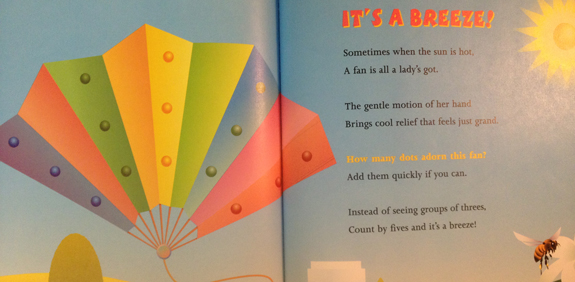
3.) I think this is a great way to teach kids about symmetry because the visuals make learning fun. The different examples are all kid friendly and connect the concept to real life so learners can relate it to their own life. I also think that it's awesome that each example not only explains symmetry but also gives facts about the thing that is being talked about. That way you're learning two things at the same time!!!
post 3
- Five Silly Monkeys is a story about monkey who jump on the bed. It is dangerous jumping on the bed and so one monkey falls off and bumps his head. The mom calls the doctor and the doctors says, “No more monkeys jumping on the bed!`” This plot continues until all the silly monkeys have fallen off the bed.
2. The story Five Silly Monkeys can be looked at with a mathematical eye. The relationship between monkey jumping occurrences is a linear function of monkeys left on the bed. It represents a linear decay because every monkey jumping occurrence takes away one monkey until their are none left jumping. This can be represented by the slope equation: Y=-1x+5. -1 is the slope because the number of monkeys goes down by one at the occurences go up by one making it negative. 5 would be the Y intercept because at 0 occurrences there are 5 monkeys.
3. It is important to teach children math through the use of children's books because it starts imagination and inventive thinking young. Giving kids numbers in stories allow them to pick up on number order. Even though it is simple math they are still learning that every time the monkeys jump another one will fall. They are learning to look out for patterns.
The Librarian Who Measured the Earth
The Librarian Who Measured the Earth
Lorena Aguilera
Lorena Aguilera

- The Librarian Who Measured the Earth is a book written by Kathryn Lasky and illustrated by Kevin Hawkes. The book is a colorfully illustrated biography of the Greek philosopher and scientist Eratosthenes, who compiled the first geography book and accurately measured the globe's circumference. Eratosthenes was born over 2000 years ago, and since a young age, he was curious and full of wonder. Eventually, he moved to Athens to learn more, and in there, he made a chronology of all the important dates in the history of Greece and wrote a book on the constellations. His name began to get around, and by the time he was 30, the ruler of egypt asked him to serve as a tutor for his son in Alexandria. He expanded his knowledge with the books he found there, especially with the ones about geography, which was his main passion. By Eratosthenes' era, people had known for sure for over 100 years that the Earth was a sphere. He started collecting information and figuring out mathematical methods to include the size of the Eath in the first complete geography book. He knew that the Earth was a sphere like a grapefruit, so he thought that if he could figure out the distance along the edge of one section and how many same-size sections it would take to make up the whole sphere, he could then calculate the whole distance around. Eratosthenes knew that every circle is made up of 360 degrees, so if he could measure the inside angle of one section, he could divide 360 by that number and know how many sections of that size would make up the whole. He learned that during the summer solstice, the angle of the sun in Alexandria would shine all the way down to Syene, another city, and that that angle would be the same angle that lay at the center of the Earth. He measured and found out that it was 7.2 degrees, so he divided 360 degrees by 7.2 and got 50: it would take 50 Alexandria-to-Syene sections to make up the circumference of the Earth. He had to determine the distance between the two cities, which was hard at the time because there were no straight roads or paths. He asked the king if people trained to walk with equal steps could be hired to measure the distance to Syene, and the king agreed. It turned out to be 5000 stades (or about 500 miles) from Alexandria to Syene. Eratosthenes then calculated the circumference of the earth. When the earth was measured using all the latest technology recently, there was only a 200-mile difference between the new figure and the one that Eratosthenes had calculated over 2000 years ago.
- The book is related to the idea of working with units. Although it gives a lot of background on Eratosthenes’ life, I think the main point that is connected to our class is the fact that he only had a few units to work with; back then they didn’t have meters or feet like he have today, much less the technology to do it precisely. He did it by applying a measuring system called stadia, a standard unit of measure during that time period that was based on the length of a typical sports stadium of the time. Eratosthenes was a pioneer in developing mathematical methods and applying them to real life.
- I think literature is an effective way to teach and learn a mathematical concept because stories attract readers and help them understand concepts more easily, especially if they include pictures or graphics.
Blog 3
1. I couldn't come up with a children's book that I read in my own childhood that demonstrated mathematical concepts off the top of my head, so I decided to find the book Lemonade For Sale by Stuart J. Murphy. This book is about four young children and their pet parrot. One day, these kids decide that they want to sell lemonade to all of the people in their neighborhood. They want to sell as much lemonade as they can in order to fix their club house! In order to track their progress, they decide that it would be a good idea to use graphs. They create a bar graph with days on the x axis and amount of lemonade on the y axis. For the first three days, their sales increase. On the fourth day, however, their sales plummet due to a street performer stealing their spotlight. On the last day, they decide to have the street performer come to their stand, and make more money than ever! They are able to fix their club house.
e
2. Lemonade For Sale is a children's book that helps children understand the function of graphing in real life. Many children may think that graphing is simply something they learn about in school. This book shows that in reality, it has many uses. Lemonade For Sale demonstrates the use of bar graphs in every day life, and how to use them to track progress as you are working toward a goal. The author shows children how to use bar graphs in everyday life in a creative way. The children track their progress by adding to the bar graph every day. On the first three days, their bars keep growing, but on the fourth day, they sell less, so the bar goes down. On the fifth day, they sell a lot of lemonade, so they have a tall bar on their graph that day. These kids realize how useful bar graphs are for tracking progress, and so will the kids that read the book.
3. I think that literature is an amazing way to teach mathematical concepts to children. When children learn about graphing in class, they may find it boring or think that it doesn't have any use in real life. Books like these teach children that graphing is a useful tool to use in life. When children learn things through literature, they don't necessarily think of it as being taught something. The end result is learning life long lessons through a book!
e
2. Lemonade For Sale is a children's book that helps children understand the function of graphing in real life. Many children may think that graphing is simply something they learn about in school. This book shows that in reality, it has many uses. Lemonade For Sale demonstrates the use of bar graphs in every day life, and how to use them to track progress as you are working toward a goal. The author shows children how to use bar graphs in everyday life in a creative way. The children track their progress by adding to the bar graph every day. On the first three days, their bars keep growing, but on the fourth day, they sell less, so the bar goes down. On the fifth day, they sell a lot of lemonade, so they have a tall bar on their graph that day. These kids realize how useful bar graphs are for tracking progress, and so will the kids that read the book.
3. I think that literature is an amazing way to teach mathematical concepts to children. When children learn about graphing in class, they may find it boring or think that it doesn't have any use in real life. Books like these teach children that graphing is a useful tool to use in life. When children learn things through literature, they don't necessarily think of it as being taught something. The end result is learning life long lessons through a book!
Blog 3
The King's Chessboard
1.The book portrays a story of a wise man who lived in India and performed a favor for the king of Deccan. The King was pleased and summoned the man to meet him. The King continually asks the wise man to tell him a reward that he would like to receive. The wise man replies that serving the King again is the only reward he would like. The King begins to get angered by the wise mans silly reward and asks him to take him seriously or else he will wish otherwise. The wise man replies with a method that for each square on the kings chessboard that he receives a grain of rice. Each day the next square would be taken and the amount of rice would double. This leaves the king thinking on how much amount of rice he is going to have to give up.
2. This story displays exponential growth and can be shown on a graph. Each day the wise man would gain more and more rice. His amount would always be growing larger than the previous amount. If the mans current value of rice was 0 his growth rate would be highly effected in a positive way. You could also potentially use a combination formula. Each day would equal n and the amount taken would be s without repetition.
3. Learning math through literature and visuals provides another way a student can understand a formula or equation. By using words and pictures instead of numbers someone could relate math to a real life scenario to better understand how the numbers work and where they come from.
1.The book portrays a story of a wise man who lived in India and performed a favor for the king of Deccan. The King was pleased and summoned the man to meet him. The King continually asks the wise man to tell him a reward that he would like to receive. The wise man replies that serving the King again is the only reward he would like. The King begins to get angered by the wise mans silly reward and asks him to take him seriously or else he will wish otherwise. The wise man replies with a method that for each square on the kings chessboard that he receives a grain of rice. Each day the next square would be taken and the amount of rice would double. This leaves the king thinking on how much amount of rice he is going to have to give up.
2. This story displays exponential growth and can be shown on a graph. Each day the wise man would gain more and more rice. His amount would always be growing larger than the previous amount. If the mans current value of rice was 0 his growth rate would be highly effected in a positive way. You could also potentially use a combination formula. Each day would equal n and the amount taken would be s without repetition.
3. Learning math through literature and visuals provides another way a student can understand a formula or equation. By using words and pictures instead of numbers someone could relate math to a real life scenario to better understand how the numbers work and where they come from.
Blog 3
1. I am doing my blog on The Great Graph Contest, by Loreen Leedy. This book is a book about a lizard (beezy) and a snail (chester) who visit there friend Gonk, Gonk is in the middle of making a graph, Beezy and Chester are infatuated with it so they decide it would be a good idea to see who can make the best graphs, thus planning a graph contest. Beezy and Gonk go all over town making different types of graphs (pie chart, line graph, bar graph.. ect) with materials they find all over the place. At the end of the book Chester is left to decide whose graphs where the best, he makes his own bar graph to determine who the winner is. At the end of the book Chester comes to the conclusion that they both had the best graphs and were both the winner
2. The Graph Contest showed great ways to make different graphs based off of different things. For example, Beezy went to a flower shop and surveyed people on what they were going to do with there flowers. 3 says they would plant them, 2 said they would sell them and, 1 said they would eat them. He then went on the make a bar graph to display there results. This book is a good first step for children as they begin there adventures into math. Just as we graph results to better understand the differences between two things (decrease or increase) the book uses graphs to also distinguish the differences between everyday items
3. I believe literature is an easy way to understand key concepts because it is a more fun way of learning, it is also easier to look back on and understand better. Because literature is something straight out of a book and not out of someone mouth you can be reassured that the answers are correct and you don't have to worry about learning it someone else's way (different people have different teaching styles) which can sometimes be hard for some people.
2. The Graph Contest showed great ways to make different graphs based off of different things. For example, Beezy went to a flower shop and surveyed people on what they were going to do with there flowers. 3 says they would plant them, 2 said they would sell them and, 1 said they would eat them. He then went on the make a bar graph to display there results. This book is a good first step for children as they begin there adventures into math. Just as we graph results to better understand the differences between two things (decrease or increase) the book uses graphs to also distinguish the differences between everyday items
3. I believe literature is an easy way to understand key concepts because it is a more fun way of learning, it is also easier to look back on and understand better. Because literature is something straight out of a book and not out of someone mouth you can be reassured that the answers are correct and you don't have to worry about learning it someone else's way (different people have different teaching styles) which can sometimes be hard for some people.
Blog3
Sydney Silverman
Math Blog 3
1) In the book “Lemonade for Sale” written by Stuart J.
Murphy and illustrated by Tricia Tusa, the members of the Elm Street Kids’ Club
realized that their clubhouse was falling down and they needed to make some
money in order to fix it. The children decide that in order to make money to
rebuild their tree house they will sell lemonade and make a bar graph in order
to keep track of their sales. They set up the graph with the number of cups on
the y-axis and the days of the week on the x-axis. They began their sale on
Monday and sold 30 cups and inputted 30 cups for Monday on the bar graph. On
Tuesday they sold 40 cups and inputted 40 cups for Tuesday on the bar graph and
made the observation that their sales were going up. On Wednesday they sold 56
cups and inputted 56 cups for Wednesday on the bar graph. On Thursday they only
sold 24 cups and inputted 24 cups for Thursday and made the observation that
the Thursday sales were lower than the sales from the past days. They realized
that the lack of Thursday sales was because their customers were busy watching
a juggler down the street. Then the children decided that the next day they would
have the juggler juggle next to their stand to attract the attention of
customers. On Friday they sold more cups than ever before and added it to the
bar graph. The Friday sales put them over their needed sales and they now had
enough money to rebuild their tree house.
2) In the book “Lemonade for Sale” the mathematical concept
of bar graphing is illustrated. Throughout the book the children use a bar
graph to record the rise and fall of their lemonade sales. In math the bar
graph uses horizontal or vertical bars to display data in order to compare
quantities. Generally one axis will represent types of categories being
compared. And generally the other axis will represent numerical values that
represent values of the data. In the book the children set up the bar graph
with the number of cups of lemonade sold on the y-axis and the days of the week
in which they sold the lemonade on the x-axis. The children were able to
visually keep track of and see how many cups of lemonade they sold on each day.
They were also able to observe the trend of their sales. By looking at the bar
graph the children were able to realize that on Monday, Tuesday, and Wednesday
their lemonade sales were increasing. Then they were able to realize that on
Thursday their lemonade sales went down dramatically which then motivated them
to make efforts to increase their sales for Friday, which eventually let them
to meet their final goal of lemonade sales. This book effectively and
creatively displays the mathematical concept of the bar graph.
3) Literature is an effective way to learn mathematical
concepts because it allows children to be taught mathematical concepts and not
think of it as learning. It makes it easier for children to understand
different concepts because they learn it as a story that is easier for them to
comprehend than a lesson in class. This literature can also include pictures
that can better illustrate mathematical concepts to children. I think literature
is a beneficial and alternative way to teach and learn mathematical concepts.
Less Than Zero
- Synopsis: I chose to do the book “Less Than Zero” by Stuart Murphy and Frank Remkiewicz. This children’s book tells the story of a penguin named Perry. He wants to buy an ice scooter, but doesn’t have the money for it. He needs 9 clams to buy one. He decides to do odd jobs in order to get the clams and keeps a graph of his earnings along the way. On the first day, his mom pays him 4 clams to trim the ice in front of his house. The next day his friend asks him to go to the circus, which costs 5 clams. He uses all of his 4 clams and owes his friend 1 clam. The next day he sees the ice cream truck and borrows another 2 clams from his friend. He was sad and decided to look around the house and finds 8 clams lying around. He is now up 5 clams because he paid back his friends. On a walk he reached into his pockets and realized they all fell out. He was still at the -3 mark in debt. The next day his neighbor told Perry that he found them all. He now had 5 clams again. The neighbor set out a deal that if Perry shoveled the ice he would get 4 clams. That equaled to 9! He passed by the ice cream truck and was tempted to buy something, but didn’t. He finally bought the scooter.
- This book teaches children about graphs and negative numbers. The book graphs out the penguin’s progress with his clams, making the graph go up and down. It teaches them about graphs and how to graph things in the real world.
- Why is literature an effective way to teach/learn a mathematical concept. Literature is an effective way to learn a mathematical concept because some kids learn in different ways. One child may understand things in a conceptual english way or a straight mathematical way. Also it is beneficial to apply math to real world settings, and children’s books do that.
Blog 3- My Mothers Chair
My Mothers Chair, written and illustrated by Vera B. Williams is a story about a little girl who's house burns down and her family trying to get back to normal life. Her "mothers chair burnt down along with he house in which they lived. This causes them to lose everything they had! Each day the girl goes to her mothers work at the "Blue Tile Diner" after school to help with little things like fill up the ketchup. When they get home, the little girl and her grandma count all the tips and save up the tips in a jar, hoping to one day buy a comfy chair so they can rest there feet somewhere after a long day at work.
This story shows the concept of exponential growth. It also teaches the concept of poverty, in which some people are unable to buy things like a chair. This story does a great job in showing the images in what is going on. The little girl saves up money from each day and at a certain time will achieve her goal, which is to buy a chair. This s exponential growth where you don't know the end number or the number of coins, but you do know the amount of time it takes, so it also teaches the children reading multiplication.
Childrens books are extremely influential on a child's life, for example even terrorist use books to teach children. We use books to teach children how to reach, about historical events and math. Using books to teach math is a fun and interactive way for children to learn without even realizing they are doing math! This is an effective way to teach math because it is a fun story and shows the importance of saving and also counting as well!
This story shows the concept of exponential growth. It also teaches the concept of poverty, in which some people are unable to buy things like a chair. This story does a great job in showing the images in what is going on. The little girl saves up money from each day and at a certain time will achieve her goal, which is to buy a chair. This s exponential growth where you don't know the end number or the number of coins, but you do know the amount of time it takes, so it also teaches the children reading multiplication.
Childrens books are extremely influential on a child's life, for example even terrorist use books to teach children. We use books to teach children how to reach, about historical events and math. Using books to teach math is a fun and interactive way for children to learn without even realizing they are doing math! This is an effective way to teach math because it is a fun story and shows the importance of saving and also counting as well!
Wednesday, November 18, 2015
Blog #3
1 I read through the Grapes of Math by Greg Tang because I don't know were to find any books about math and this one was recommended. This books uses photos and clever poems to teach how to count quickly using groups and observing symmetries. It has a variety of examples like counting rows of ants, humps on camels, or clusters of grapes. The purpose is to show that counting something one by one is tedious, while grouping things together and counting in multiples is a much faster way of counting
2 Lets take the camel poem for example, some camels have 2 humps while others have one. Counting them one by one would take longer so we can group them into collections of 5 humps. We find 2 camels that have two humps, and group them with 1 camel with one hump. We can quickly see that there are 5 of these groups of camels and can come to the conclusion that there are 25 humps.
3 This is a creative way to teach this grouping concept because it pairs visual with clever poems. The poems instruct on a certain way to group, while the pictures are fun and colorful and can capture the imagination of a child who needs to learn this concept.
2 Lets take the camel poem for example, some camels have 2 humps while others have one. Counting them one by one would take longer so we can group them into collections of 5 humps. We find 2 camels that have two humps, and group them with 1 camel with one hump. We can quickly see that there are 5 of these groups of camels and can come to the conclusion that there are 25 humps.
3 This is a creative way to teach this grouping concept because it pairs visual with clever poems. The poems instruct on a certain way to group, while the pictures are fun and colorful and can capture the imagination of a child who needs to learn this concept.
Blog 3- Probably Pistachio
1. The picture book I have selected aims to teach probability. It is titled "Probably Pistachio," by Stuart J. Murphy. The book follows a day in the life of the main character Jack. From the beginning of the book Jack is having an awful day where nothing is going his way. It begins with Jack waking up for school and he cannot find his favorite sneakers. Next he wonders whether or not he will get pastrami or tuna fish for lunch. He realizes he has a certain chance of getting what he really wants for lunch, which is pastrami. Once he gets to school he wonders whether his friend Emma will have pastrami for lunch, he notices that she will probably have pastrami because she has it usually 4 times a week excluding Thursdays. The story continues throughout Jack's day as his luck gets worse and worse. Until finally he arrives home and his mother has gone grocery shopping. He hopes that she has gotten his favorite kind of ice cream, pistachio. Jack realizes his mother has either gotten his ice cream or has not. Finally it turns out she has gotten pistachio ice cream, adding one piece of good fortune to Jack's miserable day.
2. This children's book involves a clever way of teaching kids the concepts of probability. Through using probability vocabulary such as "usually", "sometimes," "probably," and "never" it makes it seem less confusing than using real numbers. Throughout Jack's day each event he encounters involves some sort of probability such as finding his favorite sneakers or getting pastrami or tuna fish for his lunch. He knows that he has 50% chance of getting either pastrami or tuna fish for his lunch. Sadly, he gets tuna fish. Next, once he gets to school he starts thinking about what Emma will have for lunch. He uses probability vocabulary, "probably," in order to understand that there is a 4 in 5 chance she will have pastrami that day. Finally, the book is resolved with the final event of whether or not Jack will get his favorite ice cream. In this instance he realizes he has a 50% chance of getting pistachio ice cream for dessert. Although the probability used in this book is very basic it gives an introduction into probability concepts for young kids.
3. Literature is an effective way to teach young kinds math concepts, because it uses both words, pictures, and numbers in order teach concepts. The incorporation of the three make math easier to understand, because at a young age only dealing with numbers is difficult. In this book specifically the events used in order to teach probability like wondering what will be for lunch, or dessert are events young kids are familiar with and deal with on a daily basis. Due to this they have background knowledge making the concepts that much easier to process.
2. This children's book involves a clever way of teaching kids the concepts of probability. Through using probability vocabulary such as "usually", "sometimes," "probably," and "never" it makes it seem less confusing than using real numbers. Throughout Jack's day each event he encounters involves some sort of probability such as finding his favorite sneakers or getting pastrami or tuna fish for his lunch. He knows that he has 50% chance of getting either pastrami or tuna fish for his lunch. Sadly, he gets tuna fish. Next, once he gets to school he starts thinking about what Emma will have for lunch. He uses probability vocabulary, "probably," in order to understand that there is a 4 in 5 chance she will have pastrami that day. Finally, the book is resolved with the final event of whether or not Jack will get his favorite ice cream. In this instance he realizes he has a 50% chance of getting pistachio ice cream for dessert. Although the probability used in this book is very basic it gives an introduction into probability concepts for young kids.
3. Literature is an effective way to teach young kinds math concepts, because it uses both words, pictures, and numbers in order teach concepts. The incorporation of the three make math easier to understand, because at a young age only dealing with numbers is difficult. In this book specifically the events used in order to teach probability like wondering what will be for lunch, or dessert are events young kids are familiar with and deal with on a daily basis. Due to this they have background knowledge making the concepts that much easier to process.
Blog 3
1.The book I read was Lemonade for Sale by Bettina Ling. Pretty average photos are used to tell a simple story of a girl named Kate. Kate needs to make twenty dollars to buy her dad’s birthday present. With help from friends she comes up with the idea to sell lemonade. Kate and her friends sell lemonade. The first day is a success they sell 7 dollars of lemonade with a price of 50 cents a cup. Then, her little brother knocks over the lemonade. She is forced to start over so the second day she sells cookies two dollars worth with a unspecified price per cookie. The third day it rained hard so no cookies or lemonade were sold. Then the forth day when all seemed loss, a tree trimmer bought both juggs and cookies. In all Kate ended with 24 dollars and was able to buy her dad a toolbox and her friends some ice-cream.
2. One of the mathematical concepts that can be used to better understand the book is a simple line graph. The line graph that I constructed involved money earned on the 4 days of the story. On the first day she earned 7 dollars. On the second the book says she earned 2 dollars off cookies but doesn't specify any money made off of lemonade. On the third day she made no money. On the forth she ended up with 24 dollars. Because she had to keep going back to buy more lemonade and products for her stand I decided that the nine dollars that she began the story with before selling any lemonade had been spent and so adding up the days that she did work Day one and two she earned 9 dollars therefore on day four she must have earned 15 dollars to make what she ended up with 24 dollars. If more information was provided the graph could be a bit more accurate but using the information provided in the book I constructed a simple line graph.
3. For people like myself numbers and equations by themselves are confusing. Therefore adding some literature and making problems word problems helps me comprehend what is going on. I think its important for children to learn basic math at a young age in order to have a foundation to build on later on. Kids love children books so they are a perfect way to reach out and teach young people about math.

Blog 3 -- Two of Everything: A Chinese Folktale -- By: Lily Toy Hong -- August Turner
1)
One day, while digging in his garden, a poor Chinese
farmer unearths a brass pot. He takes
the pot back to his home to show to his wife.
On the way home, he drops his coin purse that held 5 coins. He puts the coin purse in the pot so he wouldn't lose it again on the way home. He gets
home and shows the pot to his wife, who bends over the pot while inspecting
it. Her one and only hair-pin falls into
the pot. She searches around for it in the pot, and
instead of finding 1 hair-pin and 1 coin purse, she finds 2 hair-pins and 2
coin purses! The couple quickly realize
the magical properties of the pot and double everything they have! However, that is not enough, they want meat
and cake and fresh fruit to double as well, but cannot afford these items. The wife devises a clever plan to come up
with sufficient funds to buy these items.
She adds the 5 additional coins from the second coin purse to the
original coin purse, which now holds 10 coins.
She puts the purse into the pot, and now they have 20 coins! They stop there, but if they continued doing the
same procedure, they would’ve grown their wealth exponentially.
2)
The mathematical concept in Two of Everything
is: doubling or exponential growth.
Although the farmers only double their coins twice (from 5 to 10, and
then 10 to 20), the story demonstrates the concept of exponential growth. They start with 5 coins, which doubled to 10
after placing the purse in the pot. They
then double the purse that has 10 coins, so they have 20 coins. They could then (the story doesn’t go in this
direction, but easily could) double the 20 coins to get 40 coins, and then
double the 40 coins to get 80, 80 to 160, 160 to 320, 320 to 640, 640 to 1280,
1280 to 2560, and so on. The expression
for this growth is 5 * 2^n, when n is greater than or equal to zero. Although this book does not go
beyond 5 * 2^2, and primarily focuses on multiplying by 2, the concept of
exponential growth is briefly introduced and lays forth the foundation of this
by describing how doubling works.
3)
Everyone enjoys a story where the protagonist(s)
end(s) up better off than where they started.
Most mathematical concepts that demonstrate an increase or growth of
some kind are a great/easy way to create a story that elevates the main
character’s position. I think children,
in fact most people, would rather learn or be taught subliminally. I know I’d prefer to read and analyze a
children’s book rather than sit in front of a text book and figure out why, for
some random reason, Sally has 5 watermelons one day and then 160 watermelons 5
days later.
Tuesday, November 17, 2015
The King's Chessboard
1. I contemplated the stories my parents read to me as a child and really struggled to find one that not only pertained to math, but more specifically the mathematical concepts we have recently studied. Thus, I decided use one of your examples and read The King's Chessboard for the first time. This story is apparently quite ancient and goes under many different titles, yet the moral of the story remains the same. The story I read was originally published in January 1988, thus I'm guessing a retelling of the old tale, and was written by David Burch; it had intensely colorful images of a world set in the past in a desert like setting. In this story a wise man refuses to accept a reward for his duties from the King, however the King insists so the wiseman decides to use this opportunity to try to outsmart the King using math. The wiseman asks the King to place grains of rice on a chessboard starting with 1 grain on the first square, and 2 on the second square, 4 on the third etc. However, by the 41st square the King realizes he is in over his head and cannot afford to give this much rice to anyone, nonetheless a commoner. The King realizes he has been tricked, and decides to trick the wiseman back by giving him a bag of rice and asks him to count every single grain within the bag, if he can do so he can have all the rice; this is in fact an impossible task due to the time the task would require. The wiseman realizes the King had tricked him back and neither give or receive any rice. Thus, one could infer it is a story of karma or the King's power or simply of greed, either way it is intellectually stimulating and interesting.
2. This story is a fascinating way to explain exponential growth. Each square the King must place rice on the grains are to be doubled. Thus, by the end of the first row of the Chessboard the King has placed 128 grains. He must do this for all 64 squares on the board, therefore by the 41st square he was to owe over a trillion grains of rice. The book is demonstrating how quickly exponential growth can occur and how easily the numbers will become increasingly larger. The author is cleverly explaining doubling and is highlighting how quickly numbers increase when doubling is involved, therefore it was inevitable, if you understand the growth pattern of 2n where n is greater than or equal to zero, that the King was to owe more grains than he possessed. This story is a perfect example of exponential growth as there is a constant increase in quantity according to the law, in this situation the wiseman's rule of doubling the grains to be placed on each square. Also, it is exponential growth, not exponential decay, because the initial value (b) is a whole number; the King must start by placing 1 grain of rice on square one thus the initial value was a whole number. Overall, the way the book intertwines exponential growth with a clever story is fascinating, yet at the same time it is written in a way that aids the reader in understanding exponential growth in a way a basic math class may not be able to provide.
3. I believe literature is an effective way to teach mathematical concepts, despite the common thought that the two are quite contradictory. I think it is valid, as many people learn in different ways, thus explaining a mathematical concept with a story could aid some in grasping the concept as words for some are easier understood than numbers, also it gives people an easy example to remember when they are applying the concept in the future. I think before I had written this post I may have argued differently, especially due to the fact I had never had a teacher read me a story in a math lesson before this class, however the story allowed me to learn about exponential growth in a different way than we had learned in class and this really helped me grasp the fundamentals. I believe it is the way the math is intertwined with a real life example that helped me to understand, therefore I think using literature to teach certain mathematical concepts is extremely useful and should be used more often.
Blog Post 3
Lea Barness
Lemonade for Sale by Stuart J. Murphy tells the story of four kids and their pet parrot who decide to sell lemonade in their neighborhood. The kids decide it is a good idea to track their progress by using graphs. On the x axis is the day of the week and the y axis is how many cups of lemonade they sold that day. One day, a boy next door starts his own business juggling for money. This made their sales of lemonade decline, which was shown on their bar graphs.
The book does a good job of showing the use of graphs and how they can be affective in tracking ones progress. When the drop in revenue occurred, this was shown numerically which makes it easier for the kids to see cause and effect of competing businesses. Graphs are a good way of creating visuals of numbers, often times plain numbers are difficult to interpret how they relate to the time passed. There are many different ways the kids could benefit from graphs. They could graph their profits, or if they wanted to show the percentage of people who liked lemonade compared to iced tea, they could use a pie graph.
Using literature to explain math is a good way to relate it to real world examples. It is difficult for many people to see how math is relevant in our daily lives. These books make it apparent to kids how we use math everyday. By using characters that kids can relate to it makes it easier for them to see themselves using math and applying it to real life.
Lemonade for Sale by Stuart J. Murphy tells the story of four kids and their pet parrot who decide to sell lemonade in their neighborhood. The kids decide it is a good idea to track their progress by using graphs. On the x axis is the day of the week and the y axis is how many cups of lemonade they sold that day. One day, a boy next door starts his own business juggling for money. This made their sales of lemonade decline, which was shown on their bar graphs.
The book does a good job of showing the use of graphs and how they can be affective in tracking ones progress. When the drop in revenue occurred, this was shown numerically which makes it easier for the kids to see cause and effect of competing businesses. Graphs are a good way of creating visuals of numbers, often times plain numbers are difficult to interpret how they relate to the time passed. There are many different ways the kids could benefit from graphs. They could graph their profits, or if they wanted to show the percentage of people who liked lemonade compared to iced tea, they could use a pie graph.
Using literature to explain math is a good way to relate it to real world examples. It is difficult for many people to see how math is relevant in our daily lives. These books make it apparent to kids how we use math everyday. By using characters that kids can relate to it makes it easier for them to see themselves using math and applying it to real life.
Blog 3
1. I sat and contemplated which children's story my mom read to me, when I was younger, that would apply to this blog. However, I was hard pressed to come up with one so I decided to use the example you provided for us called "Lemonade for Sale" by Stuart J Murphy. This is a story about a group of young children who need to raise money for a club house that needs to be repaired. So as a means of money they decide to create a lemonade stand and sell as much lemonade as possible. On the 4th day they had a lack of sales due to a street performer who was taking all the attention away from their stand. But then they had a good idea which was to bring the street performer to their stand and their sales sky rocketed! Overall, they raised enough money to fix there club house.
2. There are many mathematical aspects which reside in this childrens book. For instance they used a graph in the book in order to calculate how much money they saved up and earned. Furthermore, by doing this, they were able to observe the increase in salary which they were earning. The first few days their growth was exponential because their popularity was rising. This was a relationship between product and consumer. And on the final day, their sales went through the roof because they had the wits to combine two very successful ventures into one. (although this is more of a buissnes move then a mathematical one) Overall, the various forms of math used in this book was graphing, exponential growth and well as simple concepts like addition, subtraction and prediction which was used to account for the money needed to repair their club house.
3. Literature is an extremely effective way to teach math concepts because children dont like to do math typically and by encorporating an interesting story line, it draws them in and helps them to learn about these ideas. Also, pictorial references allows children to combine auditorial and visual learning into one which is very helpful because science shows that multiple ways to learn is a lot better for memorizing and understanding than simply one form.
2. There are many mathematical aspects which reside in this childrens book. For instance they used a graph in the book in order to calculate how much money they saved up and earned. Furthermore, by doing this, they were able to observe the increase in salary which they were earning. The first few days their growth was exponential because their popularity was rising. This was a relationship between product and consumer. And on the final day, their sales went through the roof because they had the wits to combine two very successful ventures into one. (although this is more of a buissnes move then a mathematical one) Overall, the various forms of math used in this book was graphing, exponential growth and well as simple concepts like addition, subtraction and prediction which was used to account for the money needed to repair their club house.
3. Literature is an extremely effective way to teach math concepts because children dont like to do math typically and by encorporating an interesting story line, it draws them in and helps them to learn about these ideas. Also, pictorial references allows children to combine auditorial and visual learning into one which is very helpful because science shows that multiple ways to learn is a lot better for memorizing and understanding than simply one form.
Monday, November 16, 2015
Blog 3: Rainbow Fish
1. The book titled Rainbow Fish written by Marcus Pfister is about the most beautiful fish in the ocean is asked to share one of his shining scales with a little blue fish, and to which he refuses. All the other fish in the sea leave him alone, and he wondered why. He goes to the wise octopus for advice, and she tells him to give away his scales. Rainbow Fish reluctantly does so, except for one. In the end, he is less beautiful then he was before, but he has new friends and is now the happiest fish in the sea.
2. This is an example of logarithmic growth. Every time Rainbow Fish gives away one of his shining scales to another fish the number of shining scales he has decreases, until he eventually only has one left.
3. Literature is an effective way to teach mathematical concepts because it can help you remember the process or steps on how to solve certain equations, it can make it more fun and interesting and easy to understand.
2. This is an example of logarithmic growth. Every time Rainbow Fish gives away one of his shining scales to another fish the number of shining scales he has decreases, until he eventually only has one left.
3. Literature is an effective way to teach mathematical concepts because it can help you remember the process or steps on how to solve certain equations, it can make it more fun and interesting and easy to understand.
Hop on Pop
1. For this blog I decided to read Hop on Pop, one of Dr. Seuss' most well known children's books. Like most of his work, this book involves a combination of a lot of rhyming and the clever humorous Dr. Seuss situations that most of us grew up with. There's no main focus in the book, just colorful pictures and rhymes to help young children learn how to read. This book doesn't have any major story, like Seuss' other well known children's books like The Lorax or The Cat in the Hat, since Hop on Pop meant to help children read and rhyme rather than tell a coherent story. Which means the story have no definite beginning, middle or end.
2. While this book does an amazing job in helping young children read, it also helps children learn about logic and deductive reasoning at a very young age. This book uses the common format of deductive reasoning, which is if A is B and x is A, then x is B. A good example of deductive reasoning in the story is near the end where the story talks about the brothers and how they can read little word such as if and it. The brothers can read, people can read if and it, the brothers can read if and it. Being able to read acts a A, the brothers act as B, and reading if and it is x. The major premise is the brothers can read, the minor premise is if you can read then you can read if and it the conclusion would be the brother can read if and it. That is just one of many examples of deductive reasoning in the book. The book is completely full of great examples of deductive reasoning and helps children learn the concept of deductive reasoning, without even knowing what the term deductive reasoning is.
3. Literature is a great way to teach any concept, especially mathematical concepts. It helps children learn about how certain concepts work, like deductive reasoning,without going into the complexity of it. This gives young children the general idea without confusing them too much. These types of books use fun examples of these concepts for children to make learning more enjoyable and gives them an incentive to discover said concepts. Especially if the children aren't as interested in mathematics in logic and prefer reading and storytelling instead.
2. While this book does an amazing job in helping young children read, it also helps children learn about logic and deductive reasoning at a very young age. This book uses the common format of deductive reasoning, which is if A is B and x is A, then x is B. A good example of deductive reasoning in the story is near the end where the story talks about the brothers and how they can read little word such as if and it. The brothers can read, people can read if and it, the brothers can read if and it. Being able to read acts a A, the brothers act as B, and reading if and it is x. The major premise is the brothers can read, the minor premise is if you can read then you can read if and it the conclusion would be the brother can read if and it. That is just one of many examples of deductive reasoning in the book. The book is completely full of great examples of deductive reasoning and helps children learn the concept of deductive reasoning, without even knowing what the term deductive reasoning is.
3. Literature is a great way to teach any concept, especially mathematical concepts. It helps children learn about how certain concepts work, like deductive reasoning,without going into the complexity of it. This gives young children the general idea without confusing them too much. These types of books use fun examples of these concepts for children to make learning more enjoyable and gives them an incentive to discover said concepts. Especially if the children aren't as interested in mathematics in logic and prefer reading and storytelling instead.
Sunday, November 15, 2015
Blog 3
The Very Hungry Caterpillar by Eric Carle
This Children's picture book is about a little caterpillar that seems to always be hungry! on the first day he eats 1 apple and is still hungry. So on the 2nd day he eats 2 pears and is still hungry. Every day he eats one more thing then he did before because he never seems to be able to get rid of his hunger. Then one day he turns into a marvelous butterfly.
This book is a perfect example of linear growth because every day what the caterpillar eats grows by the same amount of 1. On the first day he eats 1 on the 2nd day he eats 2 and on the 3rd day he eats 3. This sequence continues until he finally becomes a caterpillar. This pattern could be shown in linear function of y=1x+1 because he starts on the 1st day which is the Y intercept then the slope is 1 since he is eating one more thing every day. This book does a great job at explaining the concept of linear growth. Literature is a great way to teach math because it is a easy way for childreno understand more complicated concepts. Stories are a lot easier to grasp then concepts. By teaching math through literature it is also much easier to fully understand how the mathematical concepts are applied in real life.
Saturday, November 14, 2015
Sierra Stowell- The Grapes of Math by Greg Tang, Illustrated by Harry Briggs
1. Grapes of Math is written by Greg Tang. In this book the reader is given the task of figuring out how many of each item are shown by using symmetry to find quicker, easier ways to count. There are fish, grapes, snails, ants, camels, cherries, prairie mounds, pizzas, dice, strawberry seeds, windows, dots on a fan, scallops, watermelon seeds, insects, and bird eggs and each of these has a different, creative way of grouping items and counting them more efficiently. For example, the first thing the reader is asked to count is the number of fish in a school and instead of counting them one by one, Tang advises that you count the diagonals and you will see the fish in 4 groups of 4 so you will know that there is 16. The story continues on talking about grouping, imagining lines, and using symmetry to count in a more effective manor.
2. This book is difficult to summarize without explaining the mathematical concept, but the main mathematical concept in Grapes of Math is using symmetry to simplify counting. I discussed the school of fish example so I will move on to the grapes example. The book discusses adding numbers to make easy sums so the grapes are grouped into 5 groups of 10 and then you know that there are 50 grapes. For the snails, Tang hints that the reader should visualize what isn't there to make it easier. Since the snails are lined up you should multiply 5 by 5 and then count how many spaces are open and subtract that from 25. Next, Tang wants the reader to visual a square of the ants 4 across and 4 down making 16 and then counting the remaining ants that are not in the "square" giving a total of 19.
The next strategy is to add the humps of the camels by column instead of by row and then add those totals. The cherry example was very similar to the grapes example in that you have to group numbers together to make easy sums. For the prairie mound example the reader is supposed to pair the rows of mounds and figuring out how many mounds are in one group of mounds and then multiply that to get 27 and then count the mounds with prairie dogs and subtract that to get 23. The pizza is symmetrical so the trick is to count the mushrooms on one half and multiply it by 2 to get the total number of mushrooms on the whole pizza. The trick of the dice is to look at the rows instead of the pairs. Once you do that you will notice that there is 10 dots in each row and 4 rows making the total 40. The strawberry seeds are in a consecutive number order so they strategy is to add the first and the last together until you get to the middle and then add the middle two rows together. By doing this you will learn that it simply turns into 9 multiplied by 3 giving a total of 27 strawberry seeds. The window example is similar to the snails in that the reader should multiply the rows of the windows by the columns to get 35 and then count and subtract the unlit ones leaving 28 lit. For the dots on the fan, Tang wants the reader to focus on the rows instead of the columns making it 5 + 5 + 5 to make 15. Tang wants the reader to look for a pattern with the scallops and that pattern is to group them by 3 rows and notice that each group is the same so you count one and multiply it by 3 making 33 scallops. The watermelon seeds is just another example of finding easy sums to work with and the insects example is the same idea as the school of fish except once you have a total you just have to count the butterflies and inchworms and subtract them. Finally, the bird eggs strategy is to move eggs from the nest to make each nest have the same amount of eggs and then it is just simple multiplication to determine that there are 36 eggs. There are a few different mathematical concepts in this book, but the main one is using symmetry to group numbers and make them into easier sums.
3. Depending on the mathematical concept and the literature I do think it can be an effective way to teach/learn. For example, even though this is a children's book, I still learned ways to make counting large sums more simple than doing it one by one so this book is effective. I am not sure I think a picture book/ literature would be the best way to teach truth tables or things like that, but for the simpler things like symmetry or exponential growth I think it is an effective way. All of the books we have read in class have made an interesting way to introduce the mathematical concept we will be learning about and have been effective in teaching the bigger idea.
1. Grapes of Math is written by Greg Tang. In this book the reader is given the task of figuring out how many of each item are shown by using symmetry to find quicker, easier ways to count. There are fish, grapes, snails, ants, camels, cherries, prairie mounds, pizzas, dice, strawberry seeds, windows, dots on a fan, scallops, watermelon seeds, insects, and bird eggs and each of these has a different, creative way of grouping items and counting them more efficiently. For example, the first thing the reader is asked to count is the number of fish in a school and instead of counting them one by one, Tang advises that you count the diagonals and you will see the fish in 4 groups of 4 so you will know that there is 16. The story continues on talking about grouping, imagining lines, and using symmetry to count in a more effective manor.
2. This book is difficult to summarize without explaining the mathematical concept, but the main mathematical concept in Grapes of Math is using symmetry to simplify counting. I discussed the school of fish example so I will move on to the grapes example. The book discusses adding numbers to make easy sums so the grapes are grouped into 5 groups of 10 and then you know that there are 50 grapes. For the snails, Tang hints that the reader should visualize what isn't there to make it easier. Since the snails are lined up you should multiply 5 by 5 and then count how many spaces are open and subtract that from 25. Next, Tang wants the reader to visual a square of the ants 4 across and 4 down making 16 and then counting the remaining ants that are not in the "square" giving a total of 19.
The next strategy is to add the humps of the camels by column instead of by row and then add those totals. The cherry example was very similar to the grapes example in that you have to group numbers together to make easy sums. For the prairie mound example the reader is supposed to pair the rows of mounds and figuring out how many mounds are in one group of mounds and then multiply that to get 27 and then count the mounds with prairie dogs and subtract that to get 23. The pizza is symmetrical so the trick is to count the mushrooms on one half and multiply it by 2 to get the total number of mushrooms on the whole pizza. The trick of the dice is to look at the rows instead of the pairs. Once you do that you will notice that there is 10 dots in each row and 4 rows making the total 40. The strawberry seeds are in a consecutive number order so they strategy is to add the first and the last together until you get to the middle and then add the middle two rows together. By doing this you will learn that it simply turns into 9 multiplied by 3 giving a total of 27 strawberry seeds. The window example is similar to the snails in that the reader should multiply the rows of the windows by the columns to get 35 and then count and subtract the unlit ones leaving 28 lit. For the dots on the fan, Tang wants the reader to focus on the rows instead of the columns making it 5 + 5 + 5 to make 15. Tang wants the reader to look for a pattern with the scallops and that pattern is to group them by 3 rows and notice that each group is the same so you count one and multiply it by 3 making 33 scallops. The watermelon seeds is just another example of finding easy sums to work with and the insects example is the same idea as the school of fish except once you have a total you just have to count the butterflies and inchworms and subtract them. Finally, the bird eggs strategy is to move eggs from the nest to make each nest have the same amount of eggs and then it is just simple multiplication to determine that there are 36 eggs. There are a few different mathematical concepts in this book, but the main one is using symmetry to group numbers and make them into easier sums.
3. Depending on the mathematical concept and the literature I do think it can be an effective way to teach/learn. For example, even though this is a children's book, I still learned ways to make counting large sums more simple than doing it one by one so this book is effective. I am not sure I think a picture book/ literature would be the best way to teach truth tables or things like that, but for the simpler things like symmetry or exponential growth I think it is an effective way. All of the books we have read in class have made an interesting way to introduce the mathematical concept we will be learning about and have been effective in teaching the bigger idea.
Subscribe to:
Posts (Atom)